
Detailed case studies from successful NIPhD projects written by Serina Bird – Check back regularly for new articles on Australia’s groundbreaking research.
ANU & AGSCENT Collaborate Identify Diabetes in Cows
ANU & AGSCENT Collaborate Identify Diabetes in Cows
In short, the Australian National University is partnering with regional agricultural startup Agscent to develop a hand-held device using nanowire semiconductor technology to identify diabetes in cows.
- The National Industry PhD Program (NIPP) has enabled the project to pivot to an agricultural application.
- What’s next: ANU and Agscent are working on a licensing agreement that will facilitate commercialisation, and a PhD student will begin this year.
semiconductors
When we think of semiconductors, we rarely think about medical applications. However, a ground-breaking Australian National University (ANU) project, working in collaboration with regional startup Agscent, is using semiconductor nanowires to help identify diabetes in animals – from their breath. The project came out of ANU’s 2017 Grand Challenge program, Our Health in Our Hands, which aims for more precise diagnosis and personalised intervention for people affected by chronic disease, particularly diabetes and multiple sclerosis. The nanowire project uses semiconductors to perform a breath test for diabetes to reduce the number of blood tests for diabetics.
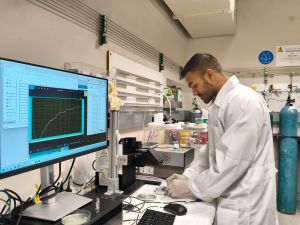
‘It’s a multidisciplinary program involving physicists like us working with engineers and health specialists to develop the sensor, understand the patients’ problem and codesign the projects,’ said Professor Lan Fu.
This project uses semiconductor technology to develop nanoscale sensors. Up until now, her group has worked with semiconductors optoelectronic devices such as lasers, photodetectors and LEDs. ‘We’ve got a lot of knowledge in that area, but we have never worked with sensors before,’ she said. ‘We know that the semiconductor nanostructures are ideal material for sensors, and the because of the diabetes project we took the opportunity to start working in this field.’
Based on her previous nanowire research, Professor Fu’s team has designed a novel nano sensor that is a group of nanowires with a contact on the end of each nanowire that can measure the resistivity change when it interacts with gas molecules. The structure has been designed to be highly sensitive to acetone, a well-known biomarker for diabetes present in human breath.
Innovation in health diagnostics for animals
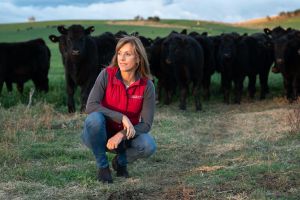
But now the project is going in a new direction, focusing on animals, following the introduction of an industry partner, Agscent Pty Ltd. Breath acetone could also be a biomarker for animal diabetes or ketosis. Agscent is a New South Wales regional startup that is developing an innovative, non-invasive diagnostic sensing technology for farm animals. Founded by Dr Bronwyn Darlington, Agscent uses hand-held devices to determine early-stage pregnancy from a cow’s breath using nanospace technology licensed from NASA and Macquarie University.
Agscent’s focus on using the breath of animals is innovative. ‘We are certainly very early as far as being pioneering in this space,’ said Dr Darlington. ‘I started developing breath-sensing technology before COVID, which was a thing when everyone thought I was just crazy. Now I’m no longer a crazy woman.’
Agscent wants to expand its technology to include a test for diabetes in collaboration with ANU.
‘The risk to animals is that often you don’t know they have diabetes until the animal is so sick it will die,’ said Dr Darlington. ‘We already have technology that collects the breath of cows in a remote field. Understanding their acetone levels can be a predictor of bloat or heat stress. Ideally, we want to test out those two specific environments where there is a very specific value add.’
Fewer needles and earlier identification
The project that ANU and Agscent are working on could ultimately mean less need for invasive diabetes testing.
‘Everyone knows that when people have diabetes, you have to do a lot of blood fingerprint testing,’ said Professor Fu. ‘It’s inconvenient, and you have to do it several times a day. And for animals, it causes discomfort and stress.’
The highly sensitive sensors being developed by ANU can measure the acetone concentration – even to an extremely low level of a few parts per billion, outperforming many other types of cetone sensor making it potentially critical for animal applications.